

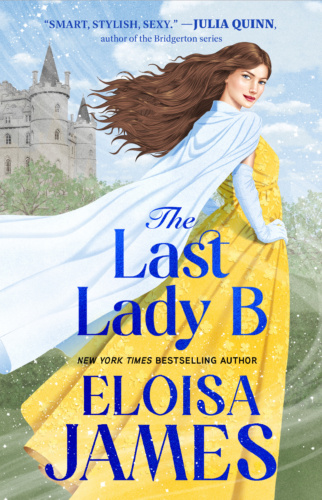

The Last Lady B
Lady B may have married Bluebeard; she may have fallen in love with a gorgeous, grumpy solicitor; she may have met a ghost and survived to tell the tale!
In the depths of winter, Lady Genevieve Hughes, her pet piglet, and her septuagenarian husband travel to a haunted abbey in the Scottish Highlands. Evie is excited to meet a ghost (perhaps one of her husband’s three previous wives), but didn’t expect the funny, quirky guests to become the friends she’s never had. And she certainly didn’t imagine meeting Sir Godric Everly, a sardonic, witty solicitor who loathes her husband.
Yet as secrets and lies turn Evie’s world upside down, Sir Godric becomes the one person whom she can trust.
When ghosts, multiple wills, and a shocking marriage certificate bring Lord Burnsby’s past crashing into his present, Burnsby promptly dies, leaving Evie free to remarry…though as a virgin wife, now a virgin widow, she is more unnerved by the marriage bed than a spectral visit.
More importantly, she has to figure out whose identity is false; whose vows are dishonorable; whose truths could destroy her reputation—and where her heart belongs.
This thrilling stand-alone novel brings all the wit and sensuality you expect from an Eloisa James novel, together with a fast-paced plot set in the Scottish Highlands!


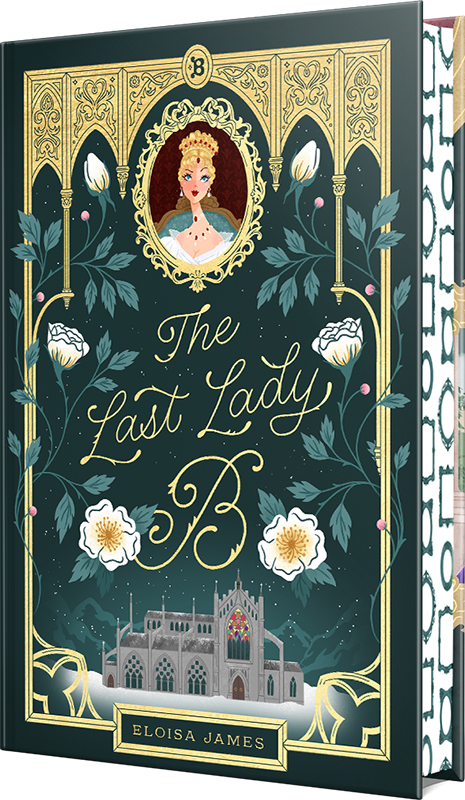 The Last Lady B is also available in gorgeous hardcover, with custom-illustrated endpapers and pretty sprayed edges. But it won’t be available in stores or through online vendors. It will ONLY be available via JQ Editions Historical Romance Subscription Box, and only for a VERY limited time. More information is on the JQ Editions Kickstarter page, and on this FAQ: How can I get The Last Lady B special hardcover edition?

Read an Excerpt →
Book Reviews →

The Last Lady B
Reviews
"Dripping with suspense and sensuality, this standalone Regency from bestseller James (the Accidental Brides series) proves she remains at the top of her game. The gothic abbey proves a perfect backdrop to their tumultuous and compulsively readable romance. It’s an unmitigated delight."
This tale of snow, specters and wolves includes intriguing mystery and gasp-inducing danger. Readers will want the good guys to win and the bad guy to get his just deserts, and James doesn’t disappoint. She also includes her trademark delectable descriptions of fashion that are as entertaining as her incorporation of literary traditions in this fun and funny historical romance.
— BookPage
VERDICT James’s latest is a delightfully charming, heartwarming, often laugh-out-loud, found-family tale.
I have long read and enjoyed James’s work, and this particular novel is fresh and a little bit zany (in the best possible way).
— BookBub
Readers will love Lady Burnsby's fortitude and marvel at the fantastic tale that uncovers more plot twists than snow on the ground during a Scottish Highland winter. Read it for the romance, but also for the pleasure of enjoying a creative masterpiece of misdirection with a side of betrayal and secrets and a truly delightful villain (or two).
The Last Lady B
Enjoy an Excerpt
Jump to Ordering Options ↓
Preface
London
May 22, 1805
“Lord Burnsby? A nasty old goat with three dead wives? He’s older than I am. For God’s sake, Genevieve, three dead wives.” My father’s cheeks had turned the color of an unripe blackberry.
I sighed.
True, Burnsby was no one’s dream husband. He was close to seventy, with the receding chin shared by many of my countrymen. Yet since I couldn’t imagine feeling passionate about any man, his chinless state and age were irrelevant.
Belying my aristocratic upbringing, I am both cynical and blunt. My sister Rosie, to the contrary, has her heart set on a blue-eyed husband, who will fall deeply in love after their first waltz. Rich and titled goes without saying.
Yet neither of us has a dowry.
Having waltzed (and flirted) with many a blue-eyed bachelor who subsequently married for money, I couldn’t bear the idea of my dreamy sister debuting in gowns that weren’t elegant enough, in gloves that had been mended, in slippers worn thin.
Without a dowry and—ipso facto—without suitors. Real ones, anyway.
“Being dead, Burnsby’s wives are irrelevant,” I informed my father. I paused and then told him the truth. “His lordship has promised to dower Rosie.”
My father’s groan evoked an unhappy Hamlet. “How shall I survive the humiliation of another man dowering my daughter!”
“No one has to know the source,” I offered. “The dowry will allow her to marry the man of her choice.”
“Our bloodline and her beauty should be enough!”
After a moment, my silence reminded my father (Lord Patrick Hughes) that bloodlines and beauty had failed me, since three years on the marriage mart had resulted in Burnsby’s proposal.
“You’re selling yourself,” Father moaned, as if the trade in women wasn’t a fact of life. Aristocratic life, anyway. “Giving up on love!”
“I prefer to think of it as bartering.” I left the question of love to the side. My years in polite society had disappointed but not surprised me, whereas Rosie would be crushed when no dashing husband materialized.
“You shouldn’t have to worry about Rosie,” Father said, humiliation writ large on his face. He wasn’t a gambler or a drunkard, by the way. He simply didn’t have any money.
For the last few days, I’d lain awake in my bed, agonizing—until I snapped and sent a message to Burnsby. He may be old, but he seemed gentle and supportive. With no more encouragement than a nod and a smile, he would happily monologue on the state of the world.
I was sick of charming younger men in the hope they would look past my shabby gloves and sweep me away to a new life. Burnsby had promised not just Rosie’s dowry, but an entirely new wardrobe fit for his wife.
(Did I negotiate these unromantic details? Yes, I did. Observation has taught me that men require advance warning of their responsibilities, preferably in writing.)
“You’re making a mistake, Genevieve,” my father warned, wagging his finger. “Burnsby is too old to father children.”
“Luckily, he is content with the heir he already has.” My father opened his mouth and I went for the killing stroke. “Frankly, imagining a wedding night makes me want to vomit.”
(Remember I said I was blunt? I am blunt.)
My father’s mouth fell open. “No lady enjoys bedding her husband. Damme, I shouldn’t have to explain that. Don’t think about it!”
“Lord Burnsby has purchased a special license,” I informed my father. “We plan to marry this morning, after which we’ll travel to his Scottish estate.” Then I added, “Before leaving the city, we will stop by his solicitor to finalize my sister’s dowry, my jointure, and my pin money.”
My father was wringing his hands, a curiously vulnerable gesture. Being English nobility, we weren’t given to displays of affection, but I came closer and kissed his cheek. “It’s not your fault.”
“Your mother would be so unhappy,” he said, sighing like a teapot on the boil.
“She would be happy for Rosie,” I pointed out. “Next year, when we return to London for the Season, I shall introduce Rosie to society from Burnsby House.”
“Don’t marry him, Genevieve! Any man might lose a wife or even two—just look at your mother, dying in childbirth—but three? That’s not just carelessness. It’s unnatural.”
I patted him on the shoulder, which didn’t help.
“People say all three of his wives were murdered,” he bleated.
“I’ve given that gossip serious consideration.”
“And?”
“Burnsby would consider homicide unbefitting his rank and presume the world would rearrange itself to his wishes. If he wanted to rid himself of a spouse, he would expect a slippery staircase to do the job for him.”
My father gulped down the rest of his whiskey.
(Well, now you’re all caught up. That’s how I dowered my sister, married a baron, and moved to Scotland.)
December 12, 1806
(After seven months of “wedded bliss”)
A letter from Genevieve, Lady Burnsby, to her sister Rosie.
Dear Rosie,
I’m writing from the village of Sifton, on the way to Lord Burnsby’s hunting lodge in the Highlands to celebrate his seventieth birthday and meet his heir. I wish I could be home for Christmas, as I shall miss you horribly. I do hope you’re well.
On a more cheerful note, I discovered a new magazine with exquisite fashion illustrations, La Belle Assemblée. When I return to London, we’ll order such a magnificent wardrobe that gentlemen will throng to leave you posies. Father promised me that he would continue paying for your dancing lessons, so do work on those tricky bits of the Polonaise.
I’m spending our journey reading novels in which heroines are beset by chilling, unearthly danger, preparing for any and all ghosts because I’ve been reliably informed by Burnsby’s housekeeper that all three of his former wives haunt the lodge! I’m intrigued by the possibility of sharing notes with my spectral predecessors, but I will keep my eyes open for other phenomena. The lodge used to be an abbey; perhaps a doleful, transparent monk paces the corridors, his head tucked beneath his arm.
Tomorrow we begin a final climb into the Highlands. After that, I won’t be able to send a letter until we return from the Grampian mountains.
I’ve been thinking about the “if you ever” game we used to play. Remember? If you ever have the opportunity to kiss a duke, run away.
I made up that game to teach you the rules of polite society. After Mother died, I speculated that only perfection would coax the ton to ignore our lack of dowries. I was a panicked eleven-year-old, and in retrospect, the answer to every etiquette question was No.
No, don’t kiss a duke.
No, don’t admit to boredom.
No, don’t laugh at jokes, at life—at men. Especially not at men.
I barely understood at the time how so important it was that I master those rules, especially Don’t laugh at men. Hopefully you won’t experience my impulse to chortle at husbandly pontificating, but not to worry: Burnsby could never guess my feelings. I have mastered the simpering paper-doll expression required of ladies.
These days I’m trying a new game, gathering advice based on experience, which we can laugh about when I see you after Christmas.
Here’s Number One:
If you ever have the opportunity to meet your husband’s (dead) former wives, consider . . . Consider what? Reconsider? Just say no? Be open to possibilities? Wave?
With much love,
Your sister Genevieve
Chapter One
The village of Sifton,
December 11
Perhaps because I haven’t yet been married for a year, I often find myself comparing my past and present life.
At this hour in the morning, unmarried Lady Genevieve would likely have been strolling in Hyde Park, whereas Lady Burnsby is strolling down Sifton’s only street—stranded in a sea of piglets. I was midway across cobblestones when a stream of small pink bodies flowed around the corner, reached me, and abruptly began folding their legs and lying down.
From the nobility to the piggery.
It has a certain je ne sais quoi, like flaunting French in a Scottish village.
Baby pigs, by the way, are not hideous. One of the few still on his feet was snuffling around my shoe (blue, heeled, embroidered with pansies). I tried to nudge him away, but he sat down and leaned against my ankle, eyes closed.
The swineherd planted his crook and gave me a toothy grin. “They’ll be awake in a minute. The last five-week-old suckling pigs of the season will fetch a pretty price at market.”
Market?
The little chap slid down my ankle and sprawled across my slipper, fast asleep. In case you don’t know, hogs and ladies do not inhabit the same universe. Pigs are like excrement or the bubonic plague: regrettable, never mentioned.
The piglet had surprisingly long, curling eyelashes and a sweet turned-up nose.
Market?
“I’ll take this one.” I bent down and scooped it into the crook of my arm, just like a baby. He snorted, but his eyes didn’t open. One ear fell against my arm like a scrap of pink velvet.
My husband emerged from the apothecary but wisely remained in the doorway. I wish I could say that he was habitually wise, but that would be a lie.
“Lady Burnsby!” he squealed, quite shocked.
The swineherd peered at me. “That’s a wee sow, yer ladyship. A female.”
“I shall name her Peony,” I said. The piglet was still sleeping peacefully, her front legs curled. “She will be a pet, my pet.”
“People may find your choice peculiar,” Burnsby remarked, having gingerly picked his way across the street, avoiding porcine nappers.
“Peculiar” is anathema to my husband. (Anathema encompasses all the actions and reactions that might brand a woman unladylike.)
I shrugged. Shrugging is vulgar (anathema!), but I find it an enjoyable sensation.
“Come along, then,” Burnsby said, giving up and waving at our coachman. Once the piglet was consigned to a groom and we were back on the road, he began crooning Joy to the World. After their only child was born on December 25th, Burnsby’s elderly parents labeled him their Miracle, which may explain why he sings Christmas hymns year around.
He has never claimed aloud to be the second Christ child, but his belief in his own judgment is never shaken.
As inviolable as if heaven-sent.
Ignoring the musical accompaniment, I began reading a new novel, aptly set in a haunted abbey. As every avid reader knows, abbeys inevitably offer ghostly accoutrement, along with an ancient housekeeper with a malign countenance, subterranean passages, a will in a secret drawer, a madwoman (or two), a scowling villain, a golden-locked hero, perhaps even a crafty devil.
So much to look forward to.
Except the hero. I find men lackluster, if not deplorable, qualities unaffected by their coloring.
“Well, here we are,” Burnsby said—one of the nonsense phrases he drops into any silence—before he launched into the fourth verse of Joy to the World.
It’s possible that his first wife, rumored to have taken her life, may have chanced the great hereafter rather than endure his daily renditions of Yuletide hymns.
I am surprised that none of his spouses resorted to homicide.
To be fair, it’s possible that one or more lost her life in an attempt to stifle a jolly rendition of his favorite hymn, A Virgin Unspotted.
After another week, during which the sound of carriage wheels competed with my husband’s baritone, our coach finally rumbled through colossal stone walls that seemed to anticipate a siege, but who would besiege a Benedictine abbey in a Scottish mountain range?
Craning my neck out the window, I saw that the abbey roof resembled a stone staircase, stepping to its ramparts. Wouldn’t that have encouraged invading hordes to scramble up, daggers clamped in their jaws?
Had Burnsby been a scholarly man, I might have inquired about the fortifications, stepped roof, and besieging warriors, but his invariable response to such questions is a blank stare.
In darker moments since my marriage to England’s most boring peer, I’ve come to the painful realization that if I wanted to chat with a vegetable, I should have propped up a gourd on my dressing table. I ward off gloom by reminding myself of Rosie’s dowry and all the exquisite garments we’ll order for her debut.
(I said I was blunt, but perhaps I should add shallow. I find that Parisian shoes, for example, make up for any number of hymns.)
As I stepped down from the carriage into the courtyard, gothic windows gazed down on us like scornful eyes with peaked eyebrows.
Despite my jaunty letter to my sister, I found myself a little unnerved.
All three of Burnsby’s previous wives died in this abbey, after all.
Just as the second carriage, carrying our personal servants, crates of tea, marmalade, marzipan, and my piglet rattled through the gates, the building’s wooden doors creaked open and household staff poured out, the women garbed in black dresses with snowy aprons, the men in rose livery.
After the abbey’s servants lined up, a few visibly shivering in the chilly air, my husband took my arm. “Good afternoon,” he shouted, sounding more energetic than usual. “I present to you my wife, Lady Burnsby.”
I inspected his blank expression, wondering if he felt déjà vu at announcing a fourth Lady Burnsby before I fixed a smile on my face and nodded at the crowd. “I am grateful for your well wishes, and I shall enjoy meeting all of you.”
As they dashed back into the lodge, the butler stepped forward and bowed. “Good afternoon, your lordship, your ladyship.”
“This is Crumpsall,” my husband said, stripping off his furred gloves. “Father of my valet, as it happens.”
The man’s neck was so lean and long that his throat emerged triumphant from his cravat, topped by a chin as sharp as a hammer’s head.
“Good afternoon, Crumpsall,” I said, wondering if his hammerlike head indicated I was meeting the requisite villainous domestic servant.
“I trust your journey was uneventful?”
“Indeed, it was, Crumpsall,” Burnsby said, handing over his gloves. “The snow held off, as did the highway men. Blasted nuisance, these outlaws. I planned to toss my wife’s piglet at their greedy heads if they showed themselves.”
Unfortunately, Burnsby had not taken to Peony. Who wouldn’t love a piggy who learned her name in two days and wags her tail for pure joy when offered a biscuit or a cuddle? He may still succumb to her charms.
My maid, Tess, came forward, handing me Peony’s leash, which matched my pelisse. My piglet, after greeting me with a cheerful grunt, sat down and gazed at around with interest. At only six weeks old, she is very intelligent.
Crumpsall wrinkled his nose, suggesting that he did not like pigs. I put him firmly in the villain category.
“May I present the lodge’s housekeeper, Miss Wellington?” he asked, ushering forward a lady some thirty years younger. Her hair was fire-red and her skin unlined: definitely not the terrifying housekeeper of fictional fame.
Miss Wellington curtsied. “Good morning, my lady. Should a groom create a pigpen in the stables, or will your pet reside in your chamber?”
“Peony would be happy with a box on the kitchen hearth,” I said. “She has a buttermilk bath every morning, if you please. This is my personal maid, Tess Hughes.”
“Good afternoon, Hughes,” the housekeeper replied, her dimples popping out. “Might I offer a refreshing cup of tea?”
As the two of them set off accompanied by Burnsby’s valet, an elderly woman rushed out the abbey door and across the courtyard.
“Aren’t you adorable!” she cried, dropping a curtsy before me. She had faded blue eyes, a corona of white curls, and a red-and-white striped gown with a rear bustle, a style outdated by some twenty years.
“Thank you,” I responded, curtsying in turn.
“Everyone addresses me as Aunt Mima, and I shall call you Genevieve, as you are now part of the family.” She grinned toothily at my husband. “Clifford.”
My husband’s name is Clifford Burnsby.
Clifford Clifton Burnsby, to be precise.
Burnsby leaned toward me and muttered, “Addled and born on the wrong side of the blanket.” He barely inclined his chin. “Good morning.”
Her birth explained why my husband hadn’t properly introduced me. Polite society insists that ladies should ignore the existence of bastards along with balls (the male kind).
I let my smile widen. “Thank you, Aunt Mima.”
“I do believe you are the most beautiful of Clifford’s wives.”
I wasn’t certain how to respond to that artless statement.
“Don’t you agree, Clifford?” Mima demanded.
“A most inappropriate observation,” he snapped.
Mima ignored that retort. “Who is this?” she asked, glancing down.
“Peony. She is six weeks old today.”
“Good afternoon, Peony,” the lady cooed, bending over for a closer look. “What a fetching leash. Are you fattening her for Christmas dinner?”
“No, she will never be anyone’s dinner,” I told her. “She is my pet.”
“A vulgar choice,” my husband said.
“Vulgar” is a potent word in polite society, a slur that can destroy a lady’s reputation. This rule comes to mind:
To carry children or dogs on a visit of ceremony is altogether vulgar. In the case of dogs, it is a thousand times better not to have them at all.
My response to his opinion? Another shrug.
Marriage has changed me. Or perhaps time has changed me, now I have reached the august age of twenty-five. Once the rules governing vulgarity are discarded, an astonishing number of choices present themselves.
To wit: if one may have a dog, why not a pig?
Perhaps there comes a time in every woman’s life when she discovers that propriety is poppycock. To put it vulgarly, propriety is bollocks.
Or perhaps that only happens to a woman foolish enough to marry a man older than her father.
A tall, scowling man emerged from the door to the abbey. Even from this distance, I could see that his coat and snowy cravat were exquisitely tailored. Perhaps that was Burnsby’s heir, Lancelot, scowling over his father’s marriage to a fortune hunter (a verdict I’ve come to anticipate from all and sundry).
Although my husband had neither this man’s jaw, his height, nor his air of command. The heir was not only more elegant but far more handsome than his father.
Mima waved. “Do come meet the new wife,” she shouted.
Not the most flattering of labels.
“There can be only one wife at a time,” she informed me, as if offering a novel piece of information.
“I am gratified to see that Sir Godric traveled from England to celebrate my birthday,” Burnsby said. So that wasn’t Lancelot, his heir.
“Godric didn’t come for your birthday, but to greet Lancelot’s new wife,” Mima countered. “Have you met her yet?”
“Of course I haven’t, since my only son chose to marry in Paris,” Burnsby said irritably. “Crumpsall, I trust that you will introduce my lady wife to the household.”
Without another word, my husband walked over to intercept his guest. After exchanging bows, Burnsby disappeared into the abbey without a backward look.
That was a surprise. Deserting one’s wife in a new location is extraordinarily impolite, and Burnsby prided himself on his gentlemanly manners. I suppressed a flash of annoyance, but his rudeness likely reflected his fastidiousness as regards illegitimate persons, even his own sister.
That didn’t reflect well on his character, but it was understandable.
Luckily, I was certain that my emotions didn’t show on my face. I was an expert at disguising unladylike emotions
“This is my son, Godric,” Mimi said, waving madly at the visitor. “Godric, this is the new Lady Burnsby.”
He bowed. “A pleasure to meet you, Lady Burnsby. My name is Sir Godric Everly. Aunt Mima, I’m not your son.”
Taken aback, I glanced between the two of them.
“Oopsie!” Mima said, slapping her cheeks with both hands. “You’re Lancelot’s school friend. I’d forget my head if it wasn’t hammered on.” She turned to me. “Back when the boys were at Eton, Godric used to spend holidays here. Now they’re not at school, he doesn’t visit.” She squinted at him, confused. “You’re not at Eton, are you, Godric?”
“No, I live in London. I am joining you this Christmas to meet Lance’s bride,” Godric said obligingly.
“I knew that! I mix the boys up, because they’re both so tall, manly, so—so… Fiddlesticks!” Mima flapped her hand around like a disgruntled bird. “Manly.”
Shoulders, chest, thick thighs shown to advantage in his breeches. A bold nose and jaw. Black, thick brows set in a straight line above black eyes. She was right: it all screamed manly.
“At any rate, Godric, isn’t Genevieve surprisingly wonderful?”
He eyed me up and down. Since his gaze conveyed undisguised contempt, my polite smile fell away.
“Surprising indeed,” Sir Godric echoed, looking as if he swallowed a gnat.
His disdain was nothing new. Neighbors to Burnsby’s country estate enjoyed making loud comments about my scheming, fortune-hunting ways. Since I had indeed married for money, I never bothered to point out that most women are forced to seek stability through marriage.
I gave Sir Godric a measured smile. “What a pleasure to meet you.”
Not.
He had a hard chin, hard eyes, hard cheekbones.
Then it occurred to me: the housekeeper had a dimple, and the anticipated ghosts had yet to appear, but the villain of the novel had duly presented himself!
Sir Godric had a wide villainous brow, tumbling black hair, dark eyes, and that forbidding demeanor. Broad shoulders, the better to dig a grave. Hessian boots and a black coat, clearly tailored by Weston. Actually, that is a surprise. Weston is expensive, and villains are usually looking for money to pay the wages of sin (Ha!).
Loathing him—compulsory for a villain—would be easy.
I made up my mind to drop “sir” when thinking of him. When a person has written you off as an exploitative sponge, it’s important to score small, albeit private, reprisals.
Crumpsall approached with a promise of tea, and we all set out for the door, Peony trotting at my heels. Halfway across the courtyard, Mima remarked out of the blue, “Godric was orphaned when his father choked to death eating stewed prunes which, as you may know, is an infallible cure for syphilis.”
I missed a step. (Syphilis is a disease more offensive than balls and bastards, never mentioned in a lady’s presence.)
“It was Lord Burnsby’s father who choked on a pit,” Sir Godric said, not unkindly. “My father died in a carriage accident.”
Interesting. Burnsby had told me his father’s weak heart had failed.
“Such a dull way to go, Godric, if you’ll forgive my plain speaking,” Mima caught my elbow, bringing me to a halt as she peered at me blurrily. “How did your father die, dear? Who was he?”
“My father, Lord Patrick Hughes, is alive and well,” I replied.
“Yet he allowed you to marry Burnsby?” Sir Godric asked incredulously.
I gave him a chilly stare. “I am not a minor. It was my decision.”
I would choose to marry Burnsby again. Probably. My life is not terrible. My husband and I are friends—or more precisely, friendly. I had made the choice to help my sister. My choice.
Rosie’s dowry and my new wardrobe have given me the fortitude to withstand bystander’s ridicule and Burnsby’s disconcerting lack of interest in my opinion.
Still, I was feeling battered, so I bent down and scooped up Peony. As her warm body snuggled into the crook of my arm, she coquettishly fluttered her eyelashes at Godric.
“Are hogs fashionable these days?” he asked, as we began walking toward the door again. His lip didn’t villainously curl, but the feeling hung in the air. A twirling-a-mustache type of condemnation.
“Absolutely,” I responded. “Every young lady—at least those in the ton—has a pig of her own. I gather you don’t move in the best circles.”
Mimi jumped in. “Godric is treasured by royalty. Prince George himself bestowed his baronetage for services to the crown.”
“No, Aunt Mima, I inherited the title from my father,” Sir Godric clarified.
I was starting to suspect that her memory loss was more serious than garden-variety forgetfulness.
Mima smiled toothily at me. “Godric is a shockingly bad-tempered barrister. I was horrified when I watched my son argue a case for the crown a year ago.”
Unsurprising. Godric’s face resembled one of those stern marble angels adorning the front of cathedrals, the ones wielding swords. Not friendly. Judgmental.
“I’m not your son, Aunt Mimi, and that was over a decade ago,” Godric said, accepting her assessment of his temper.
“He undoubtedly has a choleric liver but refuses to give up port,” Mima complained.
I paused at the door to the abbey. “You surprise me, Sir Godric. Even taking into account the evident benefit to mankind, you refuse to switch to brandy?”
“Unconscionable,” he said. I couldn’t spot even the faintest amusement in his eyes. Considering Burnsby’s lack of humor, I’ve grown to associate appreciation for irony with intelligence.
“Disappointing,” I remarked.
Did I say Sir Godric’s eyes were hard?
They hardened. No, I am not as sweet as my blush-colored cloak suggests.
Oh dear, a crushing look.
Or in reality, another crushing look. He seemed to specialize in them.
(Consider me crushed.)
Chapter Two
Number Two:
If you ever find yourself in a melodrama involving ghosts and villains, try to enjoy yourself. Compared to fiction, ordinary life is so boring.
Crumpsall ushered us through the abbey’s ponderous studded exterior doors—that siege came to mind again—into a chilly, echoing sanctuary graced by one small, unlit hearth and no furniture, save a stone altar.
Not to be blasphemous, but the altar gave off a pagan air, as if maidens were regularly thrown on top and exsanguinated.
The butler and Mima set out at a brisk walk toward a door at the far end, but I paused to stare up at the stone ribs that made up the ceiling, undoubtedly hung with cobwebs, albeit invisible in the gloom.
It was all very satisfactory. This abbey had to be ghost-ridden, if that’s a term. Haunted by monks, pale maidens—or deceased wives. I felt as if I had walked into a novel, a welcome change from the tedium of my daily life.
Godric came up beside me. “Not exactly cozy, is it?” His breath hung in the air like a puff of smoke.
“Absolutely not,” I agreed. The high windows were obscured by elaborate stone tracing and didn’t admit much light. The edges of the room were shrouded in shadow, and the air smelled sour and wet. “I assume this is the chapel?”
He nodded. “The abbey was built on a classic monasterial design. This part of the building is made up of the sanctuary and a small vestry in the rear. The chamber remains bitterly cold even in the summer—”
(Because of ghosts, obviously! But I didn’t say it aloud.)
“—so Crumpsall uses it to bury blocks of ice in hay. Some years they last into July.”
His voice was annoyingly rich and deep. I’d love to hear him speaking French, my favorite language (I can read but not speak, due to my father’s inability to pay a governess).
“The monks must have worn multiple layers of clothing.” I shivered, imagining rows of rickety wooden chairs, thin robes, and boring sermons.
“The other rooms have larger fireplaces. You’ll be warm enough,” Godric said unsympathetically.
“But monks attended eight services a day, praying and chanting. They must have suffered from frostbite.”
“Eight services? I highly doubt it.”
No wonder Godric spewed bad temper in the courtroom; people likely took offense at such a condescending display of ignorance.
“Benedictine monks attend eight mandatory services,” I informed him. “Matins, lauds, prime, terce, sext, none, vespers, compline.”
“Surely you weren’t raised Catholic?” A thin white scar bisected his right eyebrow, which didn’t stop him from incredulously raising it. hussy
(A scarred villain! Better and better.)
I shook my head. “My father doesn’t respect popes any more than bishops. I read about the services in a novel set in Sénanque Abbey, in Provence.”
Actually, I have learned everything from books, beginning with etiquette manuals after my mother’s death. Governesses never stayed long, due to my father’s inability to pay a salary.
“You read a Catholic novel in the French language?” Godric asked.
Was he incredulous about my ability to read a foreign language? Or was Catholicism the issue? I was feeling nettled by Burnsby abandoning me in a strange location, and Godric was making things worse.
“The novel was set in a haunted abbey. To be frank, I’m hoping to meet a spectral monk or two here.”
I surprised him; his mouth almost eased into a smile. “Lance and I spent our breaks from school chasing around the abbey hoping to surprise a phantom.”
“The ramparts at night?” I asked hopefully.
“Kept strictly locked. That possibility remains unexplored.”
One key question: “Are monks’ relics buried under these flagstones?”
He shook his head. “The cemetery consists of above-ground sepulchers since the ground is frozen much of the year.”
“Deaths from pneumonia due to long sermons,” said I, nodding.
“Rumor has it that a half a century ago a footman froze to death when he was accidentally locked in the chapel,” Godric offered.
“A phantom footman joins the ranks of transparent clergy!”
His eyes almost smiled at me. “In warmer months, we spent hours searching the chapel for a secret passage that supposedly begins here.”
I couldn’t help grinning. “A secret passage! How marvelous.”
“We never found a passage or a ghost, though the latter might be due to the monks’ bones having been disinterred and sent to a different cemetery by Lance’s grandfather.”
My eyes widened. Their bodies were moved? Surely an indignant monk walked the corridors, perhaps without his head, if it had been lost in transit.
“Lance and I were certain that his grandfather’s callousness would awake the dead,” Godric said, one side of his mouth quirking up. “I believe the bones were dispatched to Edinburgh. Perhaps their owners couldn’t find their way north.”
He did have a sense of humor! I laughed.
His only response was to blink as if surprised. “You didn’t marry Burnsby for money, did you?”
“Yes, I did,” I said bluntly. “Like many women in my situation, I do not have the moral high ground.”
His brow furrowed, as they say in novels, but as I wasn’t eager to bare my heart to a total stranger, I began walking again. At the end of the chapel, Godric walked through a small vestry and shoved open a thick wooden door that opened to a cloister, an open quadrangle bounded by a colonnade.
Mima was waiting for us under an arch that framed a substantial door. “This wing of the abbey was decrepit when Clifford’s father bought it,” she explained. “He rebuilt it to include a drawing room, a small parlor, a music room, and so on. You’ll find it far more comfortable than the chapel. For one thing, rats nest in the older parts of the abbey.”
I shuddered. I fake most ladylike feelings, but quivering whiskers and squinty eyes disgust me, and I’d never shared a dwelling with rodents.
“They avoid humans,” Godric said, which was some comfort, I suppose.
Crumpsall ushered us into a beautifully appointed room, its carpet and Belgian tapestries depicting flowering meadows. I might have entered a London drawing room, but for the lingering odor of damp stone.
Mima led the way toward two sofas, while the butler removed a kettle of boiling water from the fire and poured it into a large teapot. I seated myself opposite a grandiose portrait hanging over the mantel, that of a buxom lady posed before a Roman ruin, forked lightning competing with the purple ostrich plumes jutting from her wig. Presumably it depicted Burnsby’s mother or one of his previous wives (I refused to lower myself to inquire).
To be frank, it was hideous. Only deep sentiment could explain its display, as that style of portraiture fell from favor at least forty years ago. Burnsby refers to his wives by number, not name; I suspected it portrayed his mother.
Leaving the tea steeping, Crumpsall deigned to escort Peony to the kitchen after I made him promise that the household—most particularly the cook—would be informed my piglet was not to be considered pork.
Godric cleared his throat and turned to Mima. “You planned to share some information with Lady Burnsby?”
She peered at me. “Clifford didn’t warn you, did he?”
“Warn me about what?” I began to pour out tea. It would improve with another five minutes, but breakfast tea had been hours ago. My sister judges me addicted, and she’s right.
“About the occupants of the abbey.”
I smiled as I handed her a teacup. “No, my husband didn’t mention you, Aunt Mima, but I am most happy to make your acquaintance.”
“Did Clifford mention his daughter?”
The daughter was news to me. Debrett’s Illustrated Peerage of the United Kingdom hadn’t mentioned offspring other than Lancelot. I set Godric’s teacup down without filling it. “Daughter?” I echoed.
“His second wife, Hecuba, never regained her strength after giving birth to Ophelia,” Mima explained. “The poor woman died that same day.”
“Actually, it was three or four months later,” Godric clarified.
Mima patted him on the arm. “You know my wretched memory, dear. At any rate, Ophelia was born early and remained so sickly that Clifford never bothered to register her or send her away to school. Consequently, Ophelia is a wee bit eccentric.”
“Does she wish to be presented to the queen?” I asked, thinking that she must be nearly old enough to debut. Perhaps she and Rosie could attend court together.
“If so, she would debut from her half-brother’s household. You will never be asked to polish her pig-herding skills,” Godric said.
That almost sounded like a joke.
“Did your wife travel with you?” I asked him, pouring his tea.
Mima piped up. “He hasn’t yet found one. Godric, you ought to ask Burnsby for advice. Just think of the way he has wooed one marvelous lady after another.”
“Yes, just think of that,” he said.
I cleared my throat. “I could review my unmarried acquaintances.” I let my expression convey my doubt that I knew any woman who could put up with his remarkable charm (yes, that was sarcastic).
“I shall persevere without your assistance. I’d prefer my wife didn’t have a pig as her companion.”
“You might try advertising in the Times for a fluffy kitten and hope a woman comes with it,” I retorted, handing over the teacup.
I was enjoying the exchange, but Mima intervened. “Genevieve, dear, I’m sorry to say that I must sully your ears with more unwelcome news.”
Her gaze went to the portrait and back to my face. “I do hope that you will take it better than the others. Weeping strains one’s throat, and fainting runs the risk of denting your skull. Godric, do you carry a flask?”
“I do not.”
Clearly, he wouldn’t catch me if I plummeted from my chair to the ground.
“The woman in that portrait is Burnsby’s mistress,” Mima said, “painted by the famous Roman portraitist, Pompeo Batoni.”
I questioned my own ears. I don’t faint and rarely weep, but . . . A painting of my husband’s mistress—in a building where I was residing? This was extraordinarily improper.
I was genuinely shocked. My husband is ruthlessly unkind in referring to fallen women, yet he commissioned a portrait of such a woman from a “famous” painter?
His other wives must have respected Batoni’s work enough to condone the artwork—which I would not. Even if Leonardo da Vinci himself wielded the paintbrush, that painting was moving to a cowshed.
Godric raised a hand, stopping me as I was about to rise from my chair. “She lives here, in the abbey.”
end of excerpt
The Last Lady B
by Eloisa James
is available in the following formats:


UK Print:
→ As an Amazon Associate I earn from qualifying purchases. I also may use affiliate links elsewhere in my site.